-
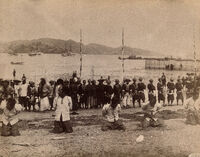
"The Kowloon City Execution Ground was the beach next to the Boundary Fence immediately south of the Walled City (see also Photo B). In this photograph it is being used for the execution of a gang of some nine or ten pirates. In the right background can be seen the Boundary Fence as it goes down to the sea (with some Hong Kong spectators clinging to it to get a good view). To the right, behind the right-hand-most pirate can be seen a few spectators being kept back from the execution site by soldiers (the civilians close to the execution site are Kowloon City Elders invited by the Magistrate)"--Ove Arup & Partners Hong Kong Ltd, op. cit. section, p. 12.40
-
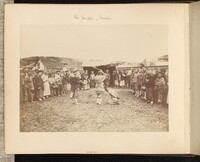
A man kneels down on the ground with his hands tied behind his back, about to be executed in public. The executioner stands next to him and holds a broad knife mid-air, ready to strike.
-
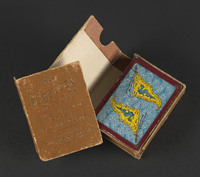
Title from box and Joker card.
-
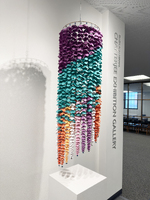
Paper, cord, resin, and glass.
-
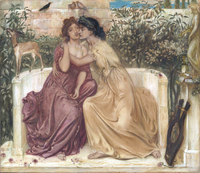
Published to accompany the exhibition held at Birmingham Museums & Art Gallery, Oct. 1, 2005-Jan. 15 2006; Museum Villa Stuck, Munich, Mar. 9-June 18, 2006; Ben Uri Gallery, the London Jewish Museum of Art, Sept. 11-Nov. 26, 2006. || Includes bibliographical references (pages 186-188) and index. || This publication marks the centenary of Simeon Solomon (1840-1905), a leading painter of the Pre-Raphaelite group that formed around Dante Gabriel Rossetti in the mid-nineteenth century. A precocious young talent, Solomon enjoyed early critical success with his paintings of biblical and classical subjects, but his public career was effectively destroyed when his homosexuality became public knowledge in 1873. Solomon is recognized today, however, as an important and influential figure in the Pre-Raphaelite circle. This book explores his work in the contexts of Pre-Raphaelitism, Judaism, and modern-day studies of masculinity.
-
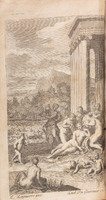
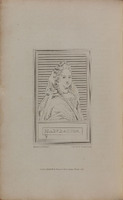
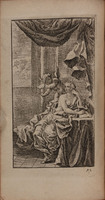
Frontispiece signed: "L. Laguerre inv., Lud. Du Guernier, sculp.". || With head- and tail-pieces. || Contributions by Pope, Swift, Gay, Tickell, Parnell, Wharton, Eusden, Philips, Budgell, Wm Harison.
-
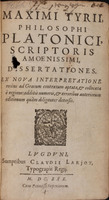
Greek and Latin texts in parallel columns. || Title vignette (printer's device?; motto: "Qui clare it laudo"); head-piece; initials. || Last page is blank. || title-leaf tightly bound, affecting text; leaf ã2 is torn, affecting text.
-
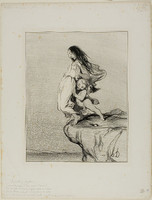
"Daumier’s 50-print series Stories from Antiquity appeared in Charivari over about a year. The Greek poet Sappho is said to have killed herself over a love affair, though specific details of her death are scant. Here Daumier added a helpful Cupid to nudge the unhinged but indecisive figure over the edge, while Charivari writers supplied verses significantly less artful than Sappho’s: Young ladies, you see where love leads us Under our feet so dainty and small The wretched chasm of an abyss Into which we eventually fall." - The Art Insitute of Chicago
-
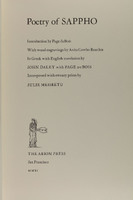
Limited edition of 400 copies.
Issued in slip case.
"Poetry of Sappho is the ninety-third publication of the Arion Press. The edition is limited to 400 numbered copies for sale and 26 lettered copies for complimentary distribution. The types are Garamont, designed by Frederic Goudy, set by hand for the translations and in Monotype composition-casting for the introduction, and digital Adobe Garamond Greek in computer-generated composition made into polymer plates for the Greek texts. The images by Julie Mehretu were printed from polymer plates and made from negatives with the emulsion scratched by the artist with an etching needle for the linear art and from scans of overlay images drawn by the artist. The wood engravings by Anita Cowles Rearden date from the 1870s and were made for a book on Sappho and Alcæus written by her husband, Judge Timothy Rearden, but never published. Original woodblocks and electrotypes made from them, on loan from the library of the Swedenborgian Church in San Francisco, were used for the printing. The presswork is by letterpress, in Italian mouldmade Revere paper. The book was designed and produced by Andrew Hoyem with the assistance of Blake Riley, Brian Ferrett, David Johnston, Christopher Godek, Mark Sarigianis, Lewis Mitchell, Sarah Songer, Rochelle Youk, Leif Erlandsson, Rachel Hooper, Lyssa Black, and Diana Ketcham. All copies are signed by the artist." --Colophon
-
<BLANK>
-

The greatest literary landmark of classical antiquity masterfully rendered by the most celebrated translator of our time. When Emily Wilson's translation of The Odyssey appeared in 2017--revealing the ancient poem in a contemporary idiom that "combines intellectual authority with addictive readability" (Edith Hall, The Sunday Telegraph)--critics lauded it as "a revelation" (Susan Chira, The New York Times) and "a cultural landmark" (Charlotte Higgins, The Guardian) that would forever change how Homer is read in English. Now Wilson has returned with an equally revelatory translation of the first great Homeric epic: The Iliad. In Wilson's hands, this exciting and often horrifying work now gallops at a pace befitting its battle scenes, roaring with the clamor of arms, the bellowing boasts of victors and the anguished cries of dying men. Wilson's unadorned but resonant language plumbs the poem's profound pathos and reveals its characters as palpably real, even "complicated", human beings. Capping a decade of intense engagement with Homer's poetry, Wilson's Iliad now gives us a complete Homer for our generation.
-
-
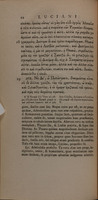
Author's name in Greek characters at head of title.
Subtitle varies, v. 10: ... accedunt variae lectiones mss. Parisiensium a Iac. Nic. Belin de Ballu collatorum ...
Greek and Latin text on each p.
Title vignettes.
"Variae lectiones et annotationes" conclude v. 1-9.
From the collection of Julius Doerner, Chicago. Purchased, 1918.
V.5. Abdicatus. Phalaris prior. Phalaris alter. Alexander seu pseudomant. De saltatione. Lexiphanes. Eunuchus. De astrologia. Demonax. Amores--v.6. Imagines. Pro imaginibus. Toxaris seu amicitia. Lucius sive asinus. Iuppiter confutatus. Iuppiter tragoedus. Somnium seu gallus--v.7. Icaromenippus. Bis accusatus. De parasito. De gymnasiis. De luctu. Rhetorum praeceptor. Philopseudes. Hippias. Bacchus. Hercules. De electro seu cycnis. Muscae encomium--v.8. Adversus indoctum. Calum. non tem. cred. Pseudologista. De Domo. Macrobii. Patriae encomium. De dipsadibus. Dissertatio cum Hesiodo. Navigium seu vota. Dialogi meretricii. De morte Peregrini. Fugitivi--v.9. Saturnalia, & Cronosolon, & Epistolae saturnales. Convivium seu lapithae. De Syria dea. Demosthenis encomium. Deorum concilium. Cynicus. Pseudosophista. Philopatris. Charidemus. Nero seu de fossione isthmi--v.10 Tragopodagra. Ocypus. Epigrammata. Epigrammata omissa. Variae lectiones et annotationes. Variae lectiones mss. Parisiensium. Indices.
-
-
-
-

Includes bibliographical references
-
Publisher's advertisements on p. [222-228].
Signatures: A¹² a⁶ B-K¹² L⁶.
"The three epistles of Aulus Sabinus in answer to as many of Ovid, made English by Mr. Salusbury": p. [203]-221. Sabinus's answers to Ovid's Epistles are lost. The ones printed in the Vicentiae 1480 ed. of Ovid , and in later editions such as this one, are actually by Angelus Quirinus Sabinus, 15th cent.
Source: Purchase, July 26, 1990.
-
Text, footnotes, and punctuation are nearly identical to pages 271-327 of T︠S︡vetaeva's "Neizdannye pis'ma k L. Ėllisu, V. Rozanovu, A. Akhmatovoĭ, O. Chernovoĭ, B. Sosinskomu, L. Pasternaku, B. Pasternaku, V. Buninoĭ, i dr., s chetyr'mi︠a︡ prilozhenii︠a︡mi" (G. Struve and N. Struve, eds.; Paris : YMCA-Press, 1972), with minor omissions, additions and variations.
Letters on pages 277-282 of "Neizdannye pis'ma ..." appear after those on pages 271-276 and 283-290, and other letters also appear in a slightly different sequence.
Text includes blank spaces where Latin-script text appears in "Neizdannye pis'ma ..." (e.g., the German poetry on page 281 of "Neizdannye pis'ma ..." is omitted on page 17).
Includes a letter to Marii︠a︡ Samoĭlovna T︠S︡etlina (née Tumarkina) from August 11, 1923 on pages 12-14.
-
-
Publisher varies.
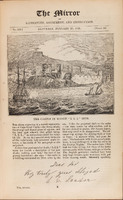
"Containing original essays; historical narratives, biographical memoirs, sketches of society, topographical descriptions, novels and tales, anecdotes, select extracts from new and expensive works, the spirit of the public journals, discoveries in the arts and sciences, useful domestic hints, etc. etc. etc."
Vols. for 1822- also called v. 1-2 annually.
Vols. for 1842-June 1847 also called v. 39-49; vols. for July-Oct. 1847 also called v. 1.
Issues for 1842-Oct. 1847 also called no. 1092-1386.
-

-
-
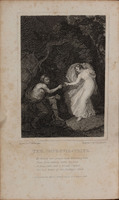
Added t.p., engr., with vignette.
Publisher's advertisements, p.[328].
C.E.B. L., v. 3, 1969, col. 531.
-