The Campus Folksong Club was active on the University of Illinois campus from the early 1960s through the early 1970s. During its height in the 1960s, the CFC had over 500 members. The University of Illinois Campus Folksong Club Oral History Project was developed by Tracie Wilson, the 2006-2007 Council on Library and Information Resources (CLIR) Fellow and folklorist with technical assistance by Tabatha Becker, Reference and Web Resources Graduate Assistant. Additional interviews were conducted by Annie Paprocki, Anthropology and Sociology Librarian.
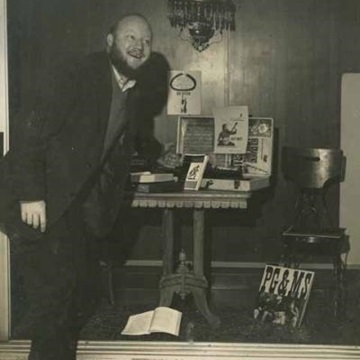
Doyle Moore was Professor Emeritus of Art and Design at the University of Illinois at Urbana-Champaign. The Autoharp was central to his scholarship and work as a performer. During the 1960s, he collaborated with University of Illinois students Jim Hockenhull and Paul Adkins as the Philo Glee and Mandolin Society, a group dedicated to old time and string band music. They performed at many Campus Folksong Club events and their music was the subject of the CFC's first LP. Doyle also hosted a monthly cooking program on WILL Radio as the station's Chef-in-Residence.
Vic Lukas, co-founder of the University of Illinois Campus Folksong Club, reads an essay about a controversial performance hosted by the club. Robert Johnson, a Black shoe shiner and carnival entertainer, was invited to play at the university. After his musical performance, the host asked him to tell about his carnival experience, which offended high-ranking university officials. Lukas considers how racism affected the reaction to Johnson’s performance.
This detailed interview with Archie Green, the faculty sponsor of the Folksong Club, begins by documenting Green’s upbringing in an immigrant enclave of California and his burgeoning class-consciousness. Although he would have preferred to work as a laborer in California, he was encouraged to become an intellectual at the University of Illinois. During his tenure as a librarian for the Institute of Industrial Relations, he helped the Folksong Club bring folk artists and folklorists to campus. A large focus of the interview is the intersection of politics and folk music. Green also discusses his relationships with various folk artists.
Archie Green reflects on his education and time as a librarian for the university’s Labor Institute. Green was hesitant to move to Urbana because it was not as progressive or exciting as San Francisco and it meant his wife and three kids would have to move their lives. As a university faculty member, Green served as the faculty advisor for the Campus Folksong Club. Green discusses the formation of the club, its members, and the musicians the club invited to perform.
Archie Green discusses the development of his aesthetics and views on folk culture. He reflects on the differences between popular folk artists and their politics. He also talks about his mother as a folk artist and Yiddish culture. The interview ends with a discussion of the lobbying process for the American Folklife Center.
Fritz Plous has worked as a freelance writer and journalist for the Chicago Sun-Times and United Press International. In his sophomore year, he discovered traditional music when he heard a freshman student, Jarvis Rich, playing a five-string banjo in the dormitory room across the hall. At Rich's suggestion, he soon became a member of the CFC, where he joined the board and was named editor of the monthly newsletter, the Autoharp. Fritz Plous currently serves as director of communications for a Chicago firm that leases railroad rolling stock and works to promote passenger-rail transportation and urban transit options in Illinois and throughout the United States.
Glenn Ohrlin is a cowboy singer and former rodeo circuit rider. He lives on a ranch near Mountain View, Arkansas. Ohrlin's music is the subject of the Campus Folksong Club's third album Hell-bound Train. During the 1960s folk revival, he performed on college campuses across the United States and produced subsequent recordings on the Philo and Rounder labels. In 1985, Ohrlin was named a National Heritage Fellow and he continues to perform at the annual National Cowboy Poetry Gathering in Elko, Nevada and at the Ozark Folk Center.