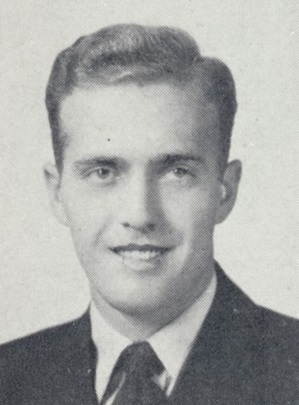
Daniel Perrino (1921-2012) began his studies at the U of I in 1940. He was active in ROTC and in a band. Daniel was at the Virginia Theater when Pearl Harbor was bombed. Along with a group of friends, Daniel talked with the President of the University about the event. He became more involved with ROTC, and eventually served the military in Japan.
Daniel Perrino was a teacher in the Music department and served as dean of student programs and services from 1968 until 1976. Perrino recounts his efforts to respond to changing needs of UI by expanding the student programs developing Quad Day as a space for diverse student groups could make connections with each other.
Danny Vogwill arrived at the University of Illinois in fall 2018, coming from an educationally minded family in Chicago. They made a last minute switch to Allen Hall, a decision which paid off – Danny eventually became an Allen RA, was deeply involved in Unit One activities, and even created, hosted, and filmed five (!) seasons of Allen Hall Big Brother. Remaining a tireless advocate for their residents even through the coronavirus pandemic, they graduated with an MCB degree in 2022. In this interview, they discuss their early life, path to college and U of I, Allen Hall and Unit One, the RA job, and navigating college before and during COVID-19.
Darius Phebus (1910-2007) graduated in 1933. He studied Liberal Arts as an undergraduate; and he later went to law school. Darius did not have a lot of money during the Great Depression. In fact, he worked for a sorority to help pay for his education and his living expenses.
David and Ann Atkins attended the University of Illinois where both earned teaching degrees in the early 1990s. In this interview, they discuss why they chose the University of Illinois, campus life, notable professors, and meeting while living at Stratford and Koinonia houses.
David Bechtel was a student at University of Illinois during the early 1960s and eventually became an assistant dean in charge of men's residences in 1969 before he moved to the undergraduate career center in 1972. Hugh Satterlee served as an administrator in various capacities from the 1960s to 1980s, including Dean of Students. In this interview Bechtel and Satterlee discuss their experience dealing with student turmoil on campus.
In the first of six interviews, Eisenman provides details of his educational experiences at Harvard and the University of Illinois, including his work reporting on the Illini Union protest on September 10, 1968. He also describes his work during the UI centennial and the creation of scholarship funds for students who could not otherwise afford the fees required to attend UIUC.
In part two of his interview, Eisenman focuses on his time working in Governor Ogilvie's administration to lower the cost of higher education by allowing the cost of tuition to rise, but providing more scholarships for low-income students. Additionally, he discusses the Illinois Blood Labeling Act, the creation of a large-scale blood drive at the University of Illinois, and local politics regarding the Champaign County Blood Bank.